
Issa-Onilu Two-Year in Office: Rebranding Nigeria Through Renewed Values, Identity, and National Consciousness

By Vivian Daniel, Abuja
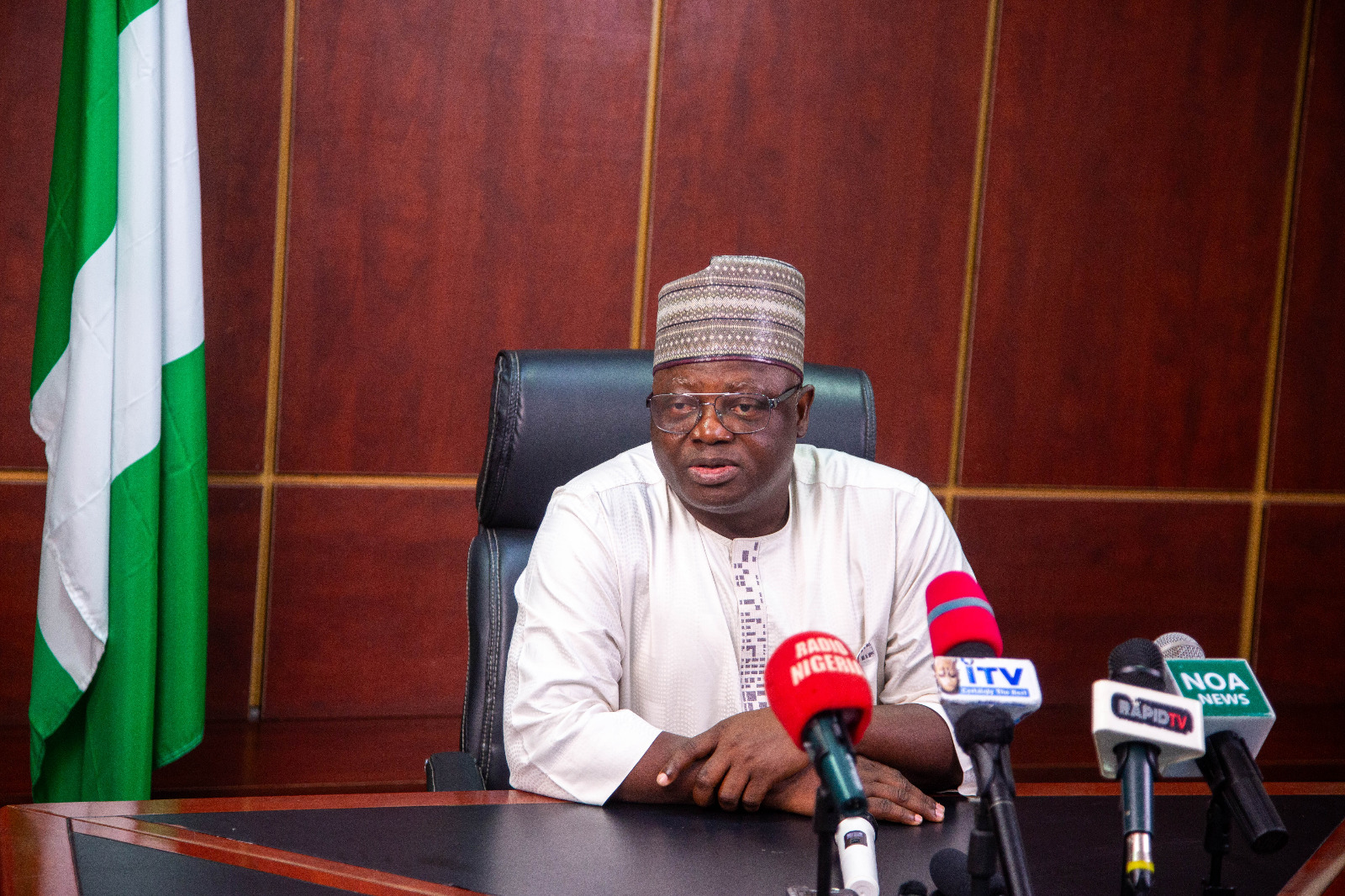
As Nigeria continue to navigate the path of national renewal, the role of public enlightenment and citizen reorientation remains ever crucial. Under the leadership of Lanre Issa-Onilu (PhD), the National Orientation Agency (NOA) has sought to bridge the gap between government policies and public understanding while shaping values, promoting unity, and reviving national consciousness. In this exclusive engagement – media roundtable – held at the NOA Headquarters, Area 1, Old Federal Secretariat, Abuja, on 22 October 2025, IanMedia joins other selected media outlets in an insightful conversation with the Director-General of the NOA on his two-year journey of redefining the Agency’s mandate, exploring the achievements recorded so far, and discuss the Agency’s renewed vision for national redirection and civic transformation. Below are excerpts from the interaction.
Question: We have the five major functions of the NOA, which are to mobilise public opinion; encourage formal education; provide feedback to the government; foster respect for the authority; and instill loyalty to the nation. In these two years, how do you think you’ve been able to achieve all of these?
Answer: I would say we have two mandates, of which all others can be embedded into. The first one is to communicate government policies, programmes and projects. And the flip side to that is also to get feedback, not just talking to the people, but also getting their feedback.
And this is done every fortnight, which gets to the highest authorities. So, the second leg is value reorientation. You see that those five can be located under these two legs of the mandate.
So, two years ago, I would say a week before two years ago, before I got here, at a time, I had the impression that this place had outlived its usefulness. I also thought the staff were the problem. Two weeks later, I regretted ever sharing such an opinion with many Nigerians, because I discovered that it had nothing to do with the personnel, as they were competent, committed and patriotic Nigerians.
Notwithstanding, there has been almost a consensus that the National Orientation Agency (NOA) is very important if the country is to be developed at whatever level, although successive governments have not given such attention to the agency as required.
As it happens, on most occasions, it went into limbo. We continued to heap the blame on the personnel as though they were reporting for their salaries, being the only thing the agency could offer. But for me, that was good news. Because I didn’t have to battle with personnel who were not willing. It was good for me to go and look for that opportunity to convince them that now we can work.
The other headache was/is, in an agency under a ministry, particularly if the head of the ministry, the minister, is not on your pace. If you have to run behind a slow coach, you can’t go far. So, I was also lucky to have a minister who’s a friend, a committed friend, a top-class administrator, who also shares the same worldview and a coach willing to put it all at our best. So, it would have been tough for us to have all the best ideas in the world, have all the energy, but you have a principal who doesn’t care about what you do. You can’t go far. Therefore, we are lucky that we work with a principal who is committed to the unity of this country. I tell people that “When you say he’s triballised, it’s almost like an insult, because he doesn’t even know tribe or religion; it’s about what can you do, what can you offer…” So, when you work with such a person… It makes all the systems ready for you.
With that in place, I told myself, let’s take the first six months to come up with a big bang. I believe in the Big Bang theory. I don’t like it when you sneak into the market. So, in the first six months, people thought we were not doing anything, even though we were really doing a lot internally to come up with a big idea. Not just for the idea’s sake, but the idea that can work for the country.
So, we got a lot of Nigerians from different segments involved – from the academic, civil society, the media, the youth, the women, everywhere to brainstorm. Mobilising Nigeria, why is it so difficult? All the past efforts, why have they not worked? And, people have made efforts in this country. Even before NOA, there have been efforts and declarations about galvanising Nigerians toward their civic responsibilities. Yet, we are where we are. You know, NOA is an easy place to run. Because you can easily deceive Nigerians. You can easily tell yourself that “Once you get here, you look for people who can make beautiful jingles to be aired. They listen to it on the radio, see it on TV stations, and they’ll say, “Ah, they are working.” But 10 years down the line, Nigeria will remain where it was or worse. So, we knew that was not the solution.
We realised that two things were missing. As beautiful as the past efforts were, without these two things, it won’t be easy to get Nigerians to be who they are supposed to be. And the common idea, the common phrase that Nigeria has been happening to people… And when we say that, it means something negative comes from Nigeria or something negative has happened to them. But we discovered that Nigeria is innocent (completely innocent) of a lot of the charges being levelled against her. Nigerians are the ones happening to Nigeria. And all of us here should begin to ask ourselves how we have been ‘happening’ to Nigeria, whether negatively or positively. Nigeria is like our beds. It is how we lay it that we are going to lie on it. So, Nigeria is not happening to any one of us. It is what we make of it that it becomes to us.
Something happened in Japan recently that’s very instructive. For 38 hours, their toing system broke down. So, all vehicles were just driving around, no payment. And during that period, there were traffic jams and machine counts as 24,000 vehicles moved around, here and there, and didn’t pay their charges, because the machines were broken down. So, it took them about eight hours to fix it. After they fixed it, 24,000 vehicle owners went back to pay without anybody asking them to do so. They went back to pay voluntarily, meaning they are ‘happening to Japan’ positively, as Japan was innocent.
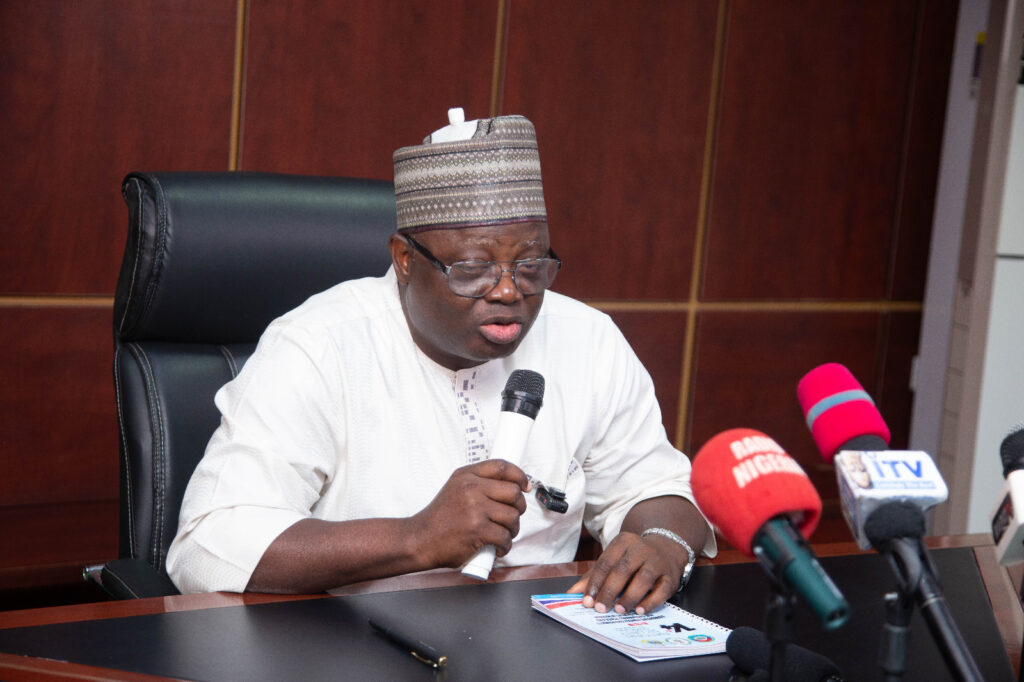
The NOA DG – Lanre Issa-Onilu
So, we discovered all of that, and we came up with the Nigerian Identity Project. Because all we have been struggling with is creating an identity for Nigeria and Nigerians. To say who we are because as a Christian, it is defined. If we see a good Christian, we know what to expect or find in him/her or a Muslim. They are clearly defined. Yes, we know there are global standards of what we consider good, but they are relative to societies. For instance, if we take the concept of freedom, freedom in America is not the same as freedom in Russia. And, they are both about freedom as a concept. If you take the concept of equity, equity in North Korea is not equity in Britain. So, we must define all these concepts relative to our culture and experiences. Every culture has its own way of doing things.
When I was asked the same question of women’s inclusion in politics and governance, as the National Publicity Secretary of the APC at a time, by a representative of the Republican Institute of the U.S., I told them that women were at fault when they accepted 35 per cent affirmative action. It is tokenism. They are at fault when they accept the Ministry of Women Affairs; where is the Ministry of Men Affairs! They are at fault when they accept a party to have special officials called National Women Leader, how about that of National Men Leader? Why are the women just being given a token, and they are happy about it? So, if you give women the 35 per cent, they are also happy about it. Why can’t you make the environment conducive for them to fight for the 100 per cent? We have underlying issues about how we mistake foreign values to influence us without releasing who we are. So, the Nigerian Identity is built around who we are, not who ‘they’ think we should be.
We also understand that it is important to document it. And part of the things that were missing in the past efforts is that even if they were documented, they were not made into a national policy. We aggregated all these views and past efforts and came up with the National Value Charter.
The National Values Charter, by the word charter, means an agreement. So, it is what Nigerians are agreeing to, not the government imposing something on the people. The National Values Charter is also curing one thing we discovered that was missing. The fact that all the past efforts, at galvanising patriotism and promoting values, were always geared towards getting the citizens to do something.
What about the leadership? Because Nigeria does not have a followership issue. We don’t have the challenge of followership. We are good followers. We are so good at following that if you show bad examples, we will also follow you. But there’s something in that to exploit. When you have good followers, all you need to do is show the right examples. Which means the leadership must come to the table. It’s not just about the followers alone.
The definition of leadership in this country is also problematic because it is narrowly defined, which is part of the agenda that we are pushing. And, until we define leadership in its true essence, we cannot get it right. When we say “Leadership” in this country, everybody’s minds would naturally go to political leadership. But that is a narrow definition of leadership. The driver in a commercial bus is a leader; likewise, the market union and community leaders, a doctor has nurses working with him or her, WhatsApp groups’ Admins, etc., are all leaders.
If the leader in any of these instances does not do the right thing, the leadership cannot work. For instance, the head of the family is where leadership starts. So, until all these leaders are brought into the basket, and they all take on the responsibility of being accountable leaders, by doing the right thing, everything remains the same.
The National Values Chapter has two components. The first leg of it is what this country has pledged to us – the Country’s Promise, like our national pledge. So, the country has already pledged to us before we pledge back. What is the pledge? The pledge is to secure our lives, provide good opportunities for us to live above the poverty line, guarantee equality and all such. These are what the country has pledged to us, which is the responsibility of all leaders that we have mentioned to fulfill on behalf of the country, to protect the citizens. The Country’s Promise is one component of the National Values Charter. It is to be fulfilled by anybody who finds himself or herself in the position of leadership of whatever form.
The second is the Citizen Codes – the Codes of Conduct, which are for the followers. You can be a follower in one circumstance, and you are a leader in some other circumstances. So, the Citizen Codes – the Codes of Conduct are clearly defined. Illustratively, imagine Islam and Christianity without the Bible and the Quran; how would you know or differentiate them? And, when you are told that he or she is a good Muslim or Christian, on what values exactly? And if you go to Chapter 2 of our Constitution, the issues about justice, equity, etc., are all clearly spelt out therein. But it has to be brought out as a Social Contract, not just a piece of legislation.
Now, we have 7 principles under the “Nigerian Promise”, meaning you are to use 7 parameters to judge any leader because that’s what the Country has promised us. And, there are also 7 principles for the “Citizens’ Codes”. There are 7 parameters to judge every single Nigerian to know whether or not he or she is a real Nigerian. We can hold ourselves accountable and self-appraise ourselves using these parameters. So, the Nigerian Identity Project is our big bang proposition. And it was when that was created that we came to the public.
Like I said earlier, we knew what we ought to do to please everybody, which would not provide solutions. So, we came out when we thought we were ready. And, the minister, since early last year, has received the blueprint. It’s already in our Acts, as a part of the National Orientation Agency (NOA) Acts. But if we commence implementation, we won’t go that far. Because we have done some tests, namely, we wrote to federal government institutions to tell them that the Flags they’re using are not the correct Flags, don’t put the coat of arms like this or like that. Unfortunately, we didn’t get any good compliance from them because the NOA has no enforcement or prosecutorial powers. What did we do? We took our case to the Federal Executive Council (FEC) to get the Acts binding. Now, we have the Nigerian Promise and the Citizens’ Codes with 7 principles respectively, so we call it 7 for 7. The leaders are given 7, and the followers are returning 7. It’s a reciprocal commitment to the country. As we realised that we have the Bible and the Quran, the Churches and the Mosque. What are the roles of the Churches and the Mosque? They are the places for nurturing based on their values. Meaning we must also have institutions to nurture Nigerians on these value systems, so that people can inculcate them.
We equally did our studies and came up with 7 Institutions of Nurturing, such that every Nigerian, no matter who you are, where you are, can easily come across these institutions of nurturing that will remind you or tell you who you are meant to be. So, we have 7 for 7 and 7. We took all of these to the FEC in September 2024, and I said that we are lucky to have a President who is committed because all our prayers – 14 of them were answered (approved). So, whenever we speak, it is no longer the NOA speaking; it is the Federal Government. So, instead of flying as a Helicopter, we can now fly as a Jumbo Jet.
One of the 7 Institutions of Nurturing is having a Compulsory Subject – called Citizenship Studies, both in Primary, Secondary and Tertiary institutions – where you must learn about what it means to be a Nigerian and be handed over the National Value Charter. At some point, you will learn Heritage and Citizenship, History, etc. Just like in your first 3 years as an international student in the UK, they are not teaching you arithmetic. They teach you about what it means to be British as well as what it means to be an American. So, it is only in Nigeria that everything goes; you have no role models, no pathways created to be followed.
The Second is Nationalisation of Cartoon Content – where 70% of our Children’s Cartoon Content is produced by Nigerians embedded with our culture, values, etc. For instance, in the last 3 decades, our children were raised on foreign values – the Cartons. At the age of 4, your young boy is jumping around in the house, and you call him active, whilst he is exhibiting Spiderman features.
The Third, Citizens Brigades – for value-driven security conduct, giving honour to the security personnel, the behavioural changes expected of the security personnel and the citizens. For instance, the Nigerian Military, FRSC, etc., can invest in the Animation industry to teach citizens certain rules. Fourth, all public officials are to undergo Values Orientation Training to know what has been promised to Nigerians. The Fifth, Industrial Training – for artisans in Nigeria – to educate them on best small business practices, among other values. The Sixth, the Standardisation of the National Symbols, like the Nigerian Passport, National Flag, etc. And, the Seventh, Global Reputation Management – Having Campaigns to tell the world who we really are by ourselves. All of these are built on the Nigerian Project.
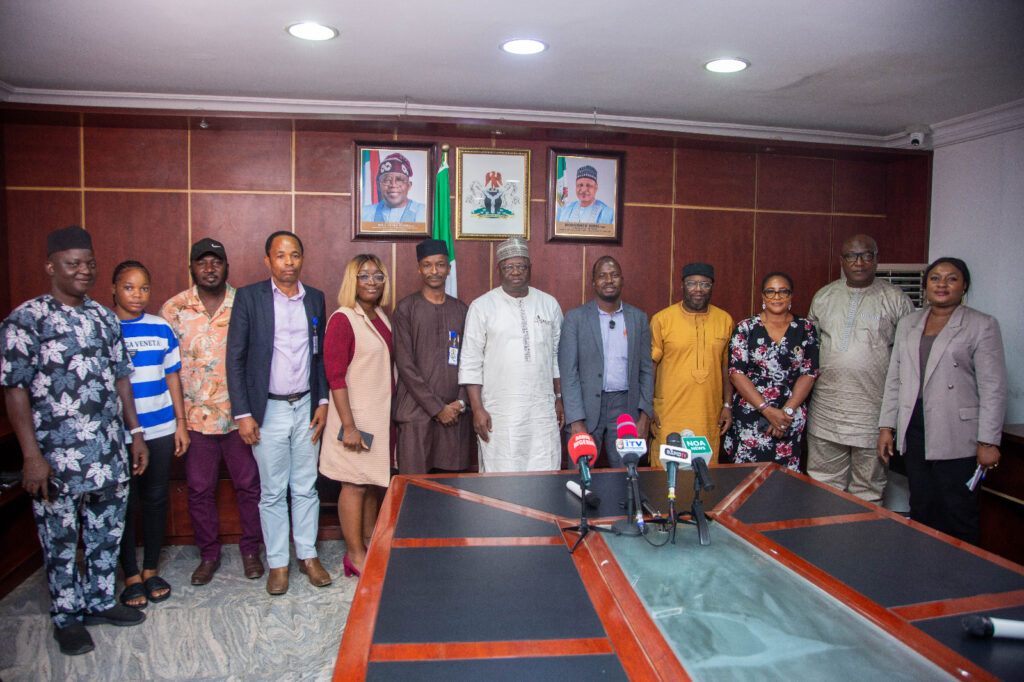
The NOA DG with the Media Practitioners
Question: You have emphasised the Nigerian Flag, but what about the man who designed it – Pa Taiwo. What legacy has been given to him or his family? And, talking about the new Heritage and Citizenship subjects, after your administration, what can you do to see that subsequent Ministers of Education take the responsibility of ensuring these new courses/subjects help the upcoming generations as well?
Answer: When this Government came, less than a year after Pa Taiwo passed on, the minister led a powerful delegation, including the former DG of NOA, to visit the family and made a promise. And, when I came in, it fell on me to fulfill the promise. I led a delegation to the family in Ibadan, where we gave them a Cheque of N30 million. The State Government has also commenced some work in terms of immortalising his name.
Also, there is a reason why we insist on getting approval on what we are doing with the Ministry of Education as well. In fact, we didn’t stop there, with getting approvals for the new subjects. There’s what we call the National Council on Information – a body comprising all the Commissioners of Information in all the 36 States. It’s a yearly Council meeting where they make decisions. The one that held early this year in Kaduna, where all of them were present, the issue of the new subjects was presented there, led by the Minister of Information, and the National Council on Information also ratified the Nigerian Identity Project, which means the States have also adopted it. It has gone beyond us.
We have all our ideas on how we want to run the campaigns but we are not full blast because we are insisting and waiting as the President who has promised to be the one to unveil the Nigerian Identity Project (NIP), while also working more to get the level of involvement, we want to bring all stakeholders aboard – the public and private sectors, civil society groups, the diplomatic community, etc., to listen to what we are saying – who we say we are. It’s a society project. Hence, a new date for the unveiling of the NIP would be given by the presidency. There’s a committee already working in preparation for the event.
Question: What is NOA doing to reach the rural communities that do not understand the English Language in order to have maximum effectiveness of its messages?
Answer: The methods I use for clients, which I developed in Marketing, are that wherever I go, the first thing I do is to study the structure on the ground. So, I look at the structure as we have NOA offices in all the local governments, in all the 36 States, FCT and the headquarters, which means we have all the structure to reach the grassroots. The next thing should be the platforms we are using to engage them. To decide the platform, we have to do what we call Audience Segmentation. As I say, those of us who learned Mass Communication are outdated if you do not understand that there’s no mass audience anymore. There is audience segmentation with different consumption tastes among the people. So, you must understand and profile all the segments to know their preferred medium and consumption habits. We see people who are TV people – Television is their primary source of information, who don’t listen to the Radio and vice versa. For instance, we produce what is called the Explainer for the Elites on a weekly basis.
The Explainer breaks down the government policies, sector by sector. For the people who watch Television, we have an engagement with what we call the Big Five television. On Social Media, we have over 300 Social Media Influencers we work with and disseminate all our information through them, of which 4 are major influencers. We also have our pages that we are running across different platforms. But you must bear in mind that the social media platforms are mainly made up of the youth who constitute the larger percentage of users. We also have 178 Radio Stations we work with on a daily basis that carry our messages all across the country. And, on the Print Media – Newspaper – we have 4 of them where we publish the NOA Explainer Plus every fortnight. So, no matter which of the media you are using to source information, the NOA would ultimately reach you.
Question: On Freedom of Expression, in recent times, there have been instances where protesters are met with resistance and stiff opposition from the security agencies. As an agency saddled with the responsibility for fostering dialogue and civic understanding, how does NOA interpret such occurrences? And, if you, the DG of NOA, were to issue a one-line Call-to-Action to Nigerians to capture and influence our behavioural change, what would it be?
Answer: The security agencies have the mandate to protect public institutions and ordinary citizens, and your resentments or anger against any issue in Nigeria does not confer on you the right to say that every citizen must join you or be prevented from going about their normal businesses. So, if your protest is going to prevent me from going to work, I also deserve protection from the security agencies to be sure you won’t prevent me from going to work. So, anybody who wants to protest should or can do so, but limit yourself to the area where you are not going to infringe on the rights of any other Nigerian. You don’t have such a right. Your right to protest, guaranteed by the Constitution, also guarantees the rights of others to go about their businesses without anybody disrupting their movements. But to say “We are going to shut down Abuja/Federal Secretariat” is not a protest; it is anarchy. That is felonious. And other people also reserve the right to rise against you to say, ‘No, we will not allow it.’ Push your agenda as a protester, but push within the law.
To capture and influence Nigerians’ behavioural change, my one-line Call-to-Action would be “Understand the difference between your country and the people you don’t like who run your country. Don’t set fire in your house because you do not like your tenant(s). Even if you succeed in killing the tenant, you would have also destroyed your property. So, Nigerians should know the difference between those who occupy the political offices they don’t like and the country that belongs to them. That’s what I’d tell Nigerians.
In Conclusion, as Lanre Issa-Onilu’s administration clocks two years, his vision for a more informed and value-driven citizenry continues to resonate through the Agency’s programmes and advocacy efforts. The NOA’s renewed visibility as one of the topmost technologically-driven agencies and its consistent engagement with Nigerians across diverse platforms underscore its evolving role in shaping the moral and civic compass of the nation.
At a time when national unity and trust in public institutions are being tested, the Agency’s emphasis on truth, inclusivity, and citizens’ education to take responsibility for their roles offers a refreshing reminder that Nigeria’s transformation begins not only with the Government policies but with the people themselves.